Relationology: a living philosophy of togetherness, from particle to planet
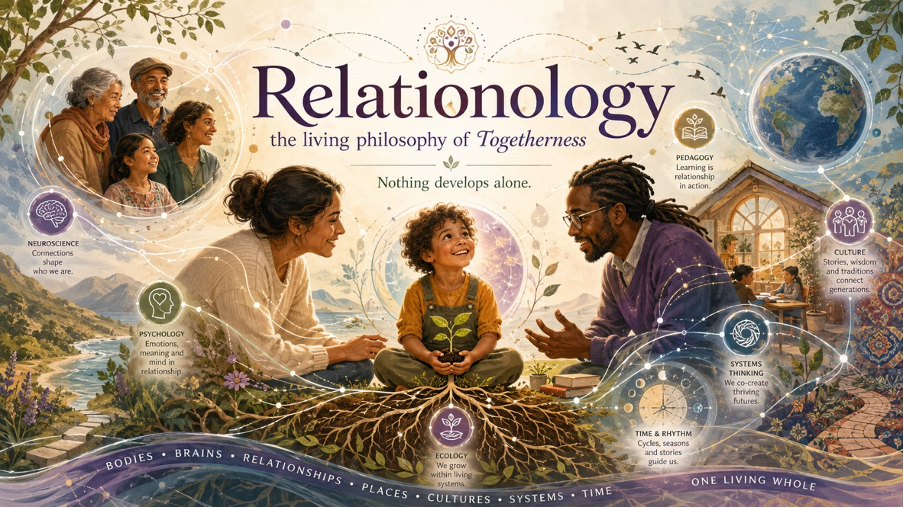
What if the next step for human flourishing is not another discipline, but a way of bringing our disciplines into relationship?
For decades, we have organised knowledge into fields.
Neuroscience studies the brain. Psychology studies the mind. Attachment theory studies relationships. Traumatology studies adversity. Education studies learning. Ecology studies environments. Leadership studies systems and organisations.
This specialisation has given us extraordinary insight.
But people do not live in disciplines.
A child is never only a nervous system.
A behaviour is never only an individual act.
A learning moment is never only cognitive.
Human development happens across bodies, brains, relationships, places, cultures, systems and time.
This is the space I call Relationology.
My 40 years working with children, family and community has enable the notion of Relationology to surface. I believe that this is the living philosophy of togetherness, a transdisciplinary study of how bodies, brains, relationships, places, cultures, time and systems co-create wellbeing, learning and development.
Its central proposition is simple:
Nothing develops alone.
Across applied neuroscience, social development theory, attachment, traumatology, polyvagal theory, social learning, positive psychology, ecological systems thinking, leadership, pedagogy, play and cultural knowledge, a common thread keeps appearing:
Relationship matters.
Not as an added extra.
As the medium through which development, growth and knowledge flourish.
Relationology is not about replacing one theory with another. It is about co-creating a meeting place where different disciplines can illuminate different parts of the same relational ecology.
Neuroscience asks:
What is happening in the nervous system?
Developmental theory asks:
What capacity is emerging?
Attachment asks:
What is happening in the relationship?
Ecological theory asks:
What surrounds the person?
Pedagogy asks:
What conditions support learning?
Systems thinking asks:
What patterns keep reproducing this outcome?
Cultural and inherited knowledge asks:
What histories, relationships and responsibilities matter here?
Relationology says:
Hold space for them all in conversation. Listen into existence other ways of knowing, doing and being. There is room at the table.
We don’t have to take on everything, but we can grow an awareness of the plethora of thought and practices that can, not only help us navigate the childhood commons, but provide dignity and honour the diverse ways of knowing and being that make up our communities.
Because the child in front of us arrives whole.
Body. Brain. Family. Culture. Place. History. Relationships. Rhythm. Identity. Possibility.
Our theories are partial views of that wholeness.
Relationology helps us reconnect them, the spheres of influence, from particle to planet (Harris, 2022).
Relationology shifts our gaze from individual deficit to the relational ecology
In doing so, it changes the questions we ask.
Instead of only:
Why can’t this child regulate?
we can also ask:
What conditions are making regulation more or less available?
Instead of:
What behaviour needs to change?
we ask:
What is this behaviour communicating about state, relationship and context?
Instead of:
How do we make the child fit the environment?
we ask:
What might the environment need to change?
That is not a rejection of individual difference.
It is a broader way of seeing.
From theory to practice
Within our own Pathways to Resilience work, Wings to Fly 2.0 ® is one practice translation of Relationology. It brings together, traumatology and pedagogy, play and neuroscience, psychology and First Nations, attachment theory and implantation sciences, relational science and ecological systems theory, intergenerational & life course approaches and child development, to name a few.
Our frameworks such as SR3®, Regulation Readiness Signal (RRS™), ENTER™, Temporal Dignity Index (TDI©), Adaptive Brain-Body States (ABBS ™), Universal Relational Scaffolding (URS ™), Allocaring and Particle-to-Planet approach of ecological systems theory of child development (Harris, 2022) are not separate projects. They are different nodes within the same relational landscape all overlapping, interacting, co-creating a collective movement of childhood wellbeing as they encounter the lived experience of community and professional wisdom of the workforce.
Each asks a different question about the conditions in which people flourish. Relationology becomes a way of thinking about the shared relational conditions through which childhood is shaped and the collective space to co-design it with children, families, community and the workforce.
A call to togethering
Relationology is not another silo.
It is an invitation.
For neuroscience to sit beside pedagogy.
For psychology to sit beside ecology.
For research to sit beside lived experience.
For professional knowledge to sit beside inherited wisdom.
For children’s voices to sit beside adult expertise.
Not so that difference disappears.
But so that difference becomes useful.
Not convergence through sameness, but coherence through relationship.
No brain develops alone.
No child develops alone.
No educator works alone.
No community flourishes alone.
We become through relationship.
That is the invitation of Relationology: a meeting place for the sciences, disciplines and knowledges that help us understand how humans flourish together.
Yours in Resilience
Dr Geraldine Harris