In honour of Early Learning Matters Week: Are We Living Through a Pedagogical Renaissance?
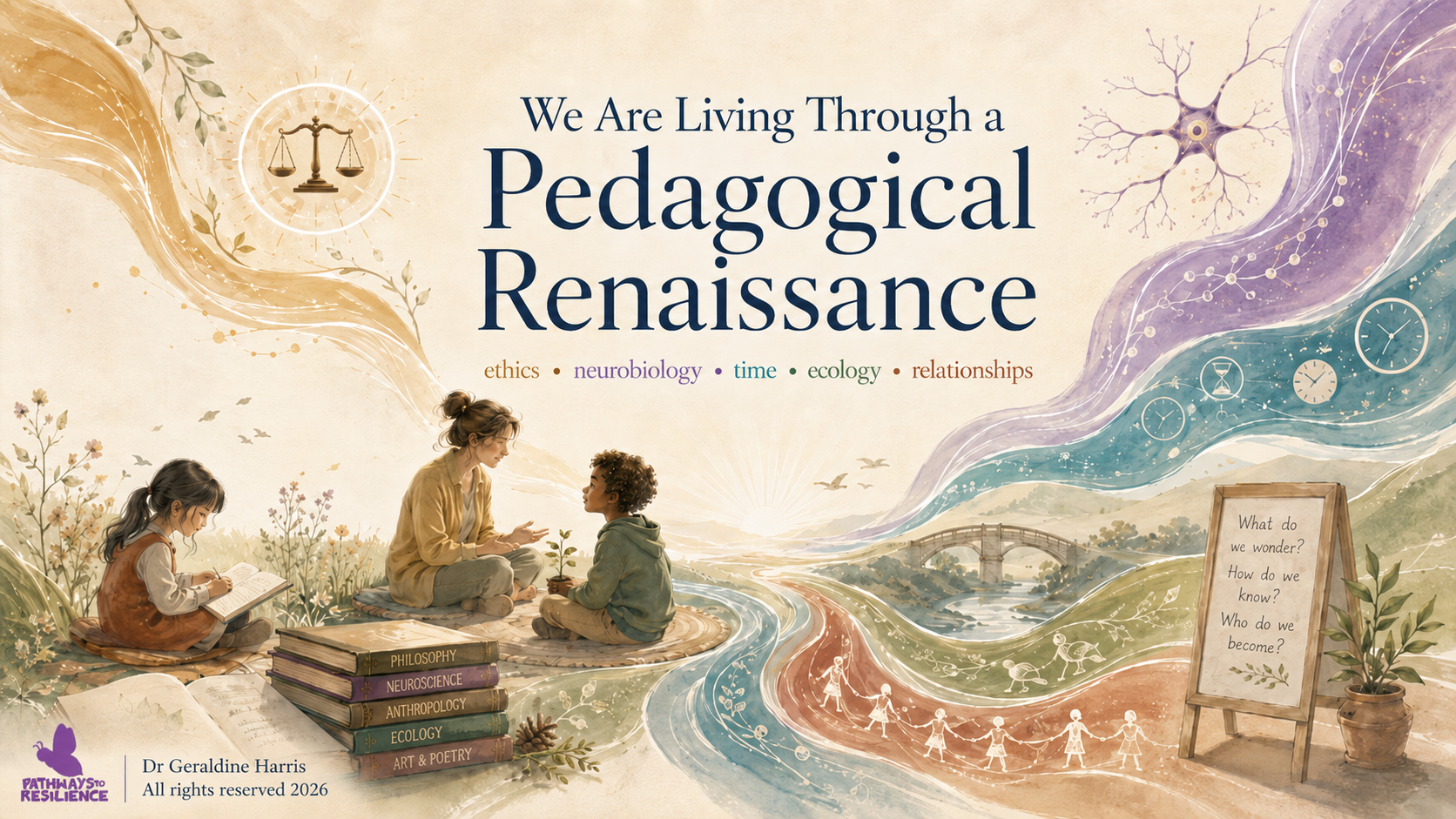
There are moments in history when a field quietly shifts beneath our feet.
When a myriad of glimmers emerge from the darkness co-creating patterns of hope.
Not because one new theory arrives.
Not because one researcher finally has the answer.
But because many voices, across many disciplines, begin asking better questions.
I wonder whether we are living through one of those moments now.
Perhaps we are experiencing a pedagogical renaissance.
Not a rejection of what came before, but a joyful rediscovery of childhood itself.
For generations, education often imagined children as passive recipients of knowledge. They were expected to sit still, absorb information and patiently wait to become capable adults. Childhood was something to move through rather than something to honour.
Yet across the world, courageous thinkers have gently, and sometimes courageously, disturbed that image.
Loris Malaguzzi and Carla Rinaldi invited us to see children as rich with potential, capable of constructing meaning through a hundred languages. They reminded us that education begins not with instruction, but with relationship, curiosity and wonder.
Stephen Porges, Bruce Perry, Daniel Siegel and Tina Payne Bryson invited us beneath behaviour into the living architecture of the nervous system. They helped us understand that regulation, safety and connection are not peripheral to learning—they are the conditions from which learning emerges.
Sue Grieshaber, Ann Farrell, Anne-Marie Clark, Peter Moss and Karin Murris challenged us to rethink power, participation and the politics of childhood. They asked us to notice whose voices are heard, whose knowledge is privileged and whose stories remain untold.
Donna Haraway, Veronica Pacini-Ketchabaw, Robin Wall Kimmerer, Karen Barad and Rosi Braidotti invited us to see that children never develop in isolation. We are entangled with places, materials, more-than-human worlds, histories and futures. Childhood is not simply located within the child but emerges through relationships with everything around us.
Stuart Lester, Wendy Russell, Peter King and Jennifer Cartmel reminded us that play, place and community are not luxuries. They are the living ecologies through which children rehearse belonging, agency and participation.
Tyson Yunkaporta, Chelsea Watego, Tom Calma, Lowitja O'Donoghue, Bessarab, Arabena and Karen Martin and so many First Nations scholars and knowledge holders, have invited us into ways of knowing that have always understood learning as relational, ecological, temporal and deeply ethical. They remind us that many of the ideas we now celebrate as innovations have long existed within enduring Indigenous knowledge systems that centre Country, kinship, reciprocity and collective responsibility.
None of these scholars are saying exactly the same thing.
Nor should they.
A renaissance is never a chorus singing in perfect unison.
It is a conversation. It creates ethical friction, creative critical reflections.
A movement.
A collective disturbance of assumptions that no longer serve us.
Perhaps that is what makes this moment so exciting.
Neuroscience is speaking with philosophy.
Early childhood education and care is speaking with ecology.
Trauma studies are speaking with ethics.
Indigenous knowledges are speaking with systems thinking.
Play is speaking with executive functioning.
Relationships are speaking with biology.
The boundaries between disciplines are becoming more porous, and in those spaces something beautiful is beginning to emerge.
Not a single new theory.
But a new way of seeing.
For me, this has become the Pathways work of ENTER ™.
ENTER™ is not an attempt to replace these remarkable contributions.
It is an invitation to sit among them.
To listen.
To notice the conversations unfolding between ethics, neurobiology, time, ecology and relationships.
To ask not only How do children learn? but Under what conditions do children flourish?
Perhaps this is why I have found myself thinking beyond Malaguzzi's hundred languages towards the thousands of body dialects that children speak.
Not because the hundred languages are incomplete.
But because every language is spoken through a body shaped by relationships, culture, biology, place, time and lived experience.
The renaissance is teaching us that there is no universal child.
There are children.
Each carrying unique histories.
Each becoming within unique ecologies.
Each deserving educators who approach them with humility before certainty, curiosity before correction and relationship before judgement.
Perhaps this is what every renaissance has always required.
Not certainty.
But courage.
The courage to disturb comfortable assumptions.
The courage to borrow generously across disciplines.
The courage to remain learners ourselves.
The masters who have shaped this field did not invite us to imitate them.
They invited us to continue the conversation.
Perhaps our responsibility now is not to preserve their ideas unchanged, but to carry forward the same spirit of joyful disturbance that first inspired them.
The future of pedagogy may not belong to those who defend disciplinary borders.
It may belong to those willing to walk between them. This is our time for a pedagogical renaissance.
Yours in Resilience
Dr Geraldine Harris
#TogetherWeCan #ENTERtheResnaissance