The Pedagogy of Presence: A Different Kind of POP Culture
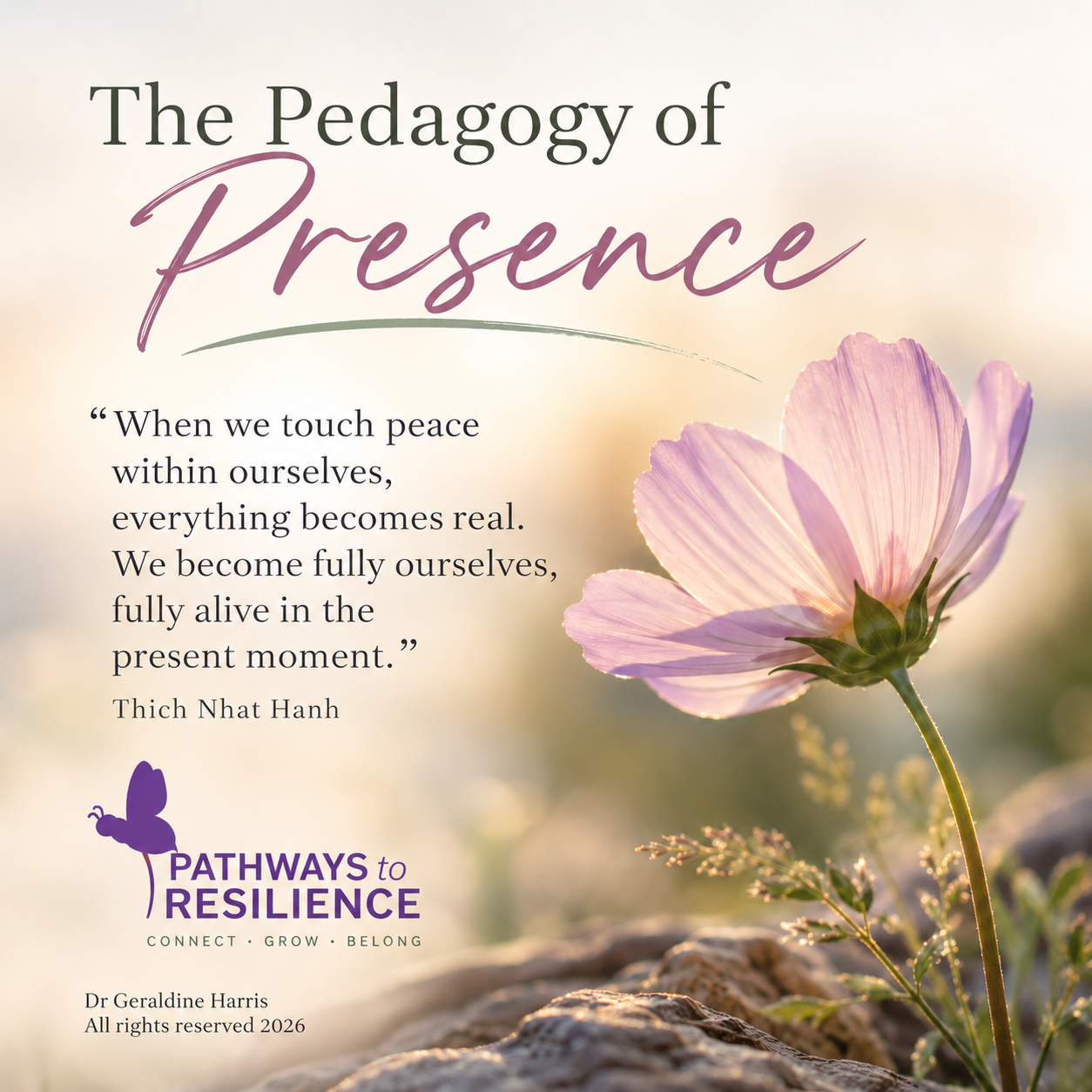
For World Mental Health Day from Pathways to Resilience
“When we touch peace within ourselves, everything becomes real. We become fully ourselves, fully alive in the present moment.” Thich Nhat Hanh
What if the most important thing we could offer ourselves, and one another, is something we already have?
Our presence.
Not another strategy to master. Not another demand to meet. Not another version of ourselves to fix. Just the opportunity to arrive, as we are, in the moment we are living.
We live in a world that can make importance feel like urgency. The next task, the unanswered message, the problem to solve, the person who needs us. Our attention is continually drawn towards what comes next, sometimes at the expense of noticing what is here, in the moment.
We know importance and urgency are not the same thing but in the busy-ness of everyday life they become conflated.
Sometimes, the important thing is to pause. To ground ourselves, to notice our breathing, feel our feet on the ground, listen to the birds, or recognise the warmth of another person’s presence. To give ourselves permission to be human before we try to do another humane thing for others.
At Pathways to Resilience we call this our POP culture:
The Pedagogy of Presence.
Presence is not about getting ourselves perfectly calm, silencing our thoughts or fixing our bodies, brains and minds. It is about making room for ourselves to notice what is happening within us and around us, without immediately needing to change it.
It is the gift of the moment. To float within, what is.
When we make space to be present with ourselves, we begin to notice the small things that remind us we are alive, joyful and curious creatures. A glimmer of sunlight through the trees. A shared laugh. The relief of being heard. The awe when we observe the curiosity of a child. The quiet satisfaction of something growing, connecting or coming together.
These moments may seem insignificant beside the demands of everyday life. Yet they can offer us something important: opportunities to reconnect with ourselves, to experience mattering, and to recognise possibilities that urgency can obscure.
Perhaps this is part of what it means to invest in our own flourishing. Not waiting until everything is resolved, everyone is okay or life becomes less complicated, but finding ways to participate in the life that is already unfolding around us.
And presence does not stop with ourselves. It is part of our co-generative pedagogical processes and everyday decision-making with children, families and the environment.
When we can be present with another person, without rushing to correct, reassure, advise or fix, we offer something profoundly human. At Pathways we call this Proximity without Pressure. We make room for another person’s experience to exist alongside our own. We can listen a little longer, notice a little more, and meet one another with greater curiosity and compassion.
Sometimes, being alongside someone is more important than knowing what to say. Our presence is enough.
The same is true of our relationship with the living world. When we pause long enough to notice the changing light, the rhythm of the wind, the feel of the earth beneath our feet, we are reminded that we are not separate from the world around us. We are part of it, continually shaped through our relationships with people, places and the more-than-human world.
This World Mental Health Day, perhaps we might offer ourselves a different invitation.
Rather than asking, “What do I need to fix?” we might ask, “What am I noticing?”
Rather than measuring the day by everything we have accomplished, we might notice the glimmers and sparks that have made it meaningful.
Rather than waiting until we have everything together, we might recognise that we can begin where we are, with what we have, and with the people and places already alongside us.
Flourishing is not a solitary achievement. It emerges, in part, through the conditions we create for ourselves and one another to feel present, connected and able to participate in life.
The Pedagogy of Presence is not about stepping away from the world. It is about being more fully in it. It’s reminding ourselves that not everything that is important is urgent?
And perhaps, when we learn to give ourselves that gift, we become a little more able to offer it to others.
One moment. One connection. One shared human journey.
My provocation for today:
What might become possible if, we give permission to ourselves to slow down and be in the moment with our bodies-brains-minds?
Yours in Resilience
Dr Geraldine Harris
Pathways to Resilience
Resilient Children. Strong Families. Connected Communities.