Tell Me It’s Not Magic
Go on. Tell me it’s not magic. Tell me that a toddler’s grin
doesn’t somehow dissolve the longest meeting, soften the hardest day, and make
grown adults crouch down to floor level without even thinking. Tell me it’s just biology
when a baby reaches both arms towards you and your own arms answer before your
brain has caught up. Perhaps it is biology. But biology, at its best, can feel
wonderfully like magic.
Walk into any early childhood education and care setting and
you will find tiny alchemists quietly at work. They arrive carrying no wallets, no
résumés, no job titles. Yet somehow they transform entire rooms. One giggle
becomes twenty. One curious “Why?” becomes an expedition. One muddy puddle
becomes an ocean. One cardboard box becomes a spaceship, a bakery, a dinosaur
cave and a family home before morning tea. Who taught them that? Certainly not the
cardboard or did it? Children have an extraordinary talent for turning ordinary things
into extraordinary experiences. They don’t simply see the world; they keep making it
new.
They are collectors of wonder. Architects of possibility. Guardians of the ordinary
made extraordinary. Their chemistry works on us too. Their eyes search for ours, and
somehow we search back. Their tiny fingers wrap around one of ours and suddenly
the rest of the world can wait. The sweet scent of a baby’s head, the infectious belly
laugh of a three-year-old, the determined concentration of a child trying, ever so
carefully, to pour water without spilling it… these moments seem to rearrange
something inside us.
Our bodies lean in. Our voices soften. Our breathing slows. Without anyone giving
us instructions, we begin to notice. To wonder. To care. To protect. To delight. We
become, almost without noticing, a little more human. Perhaps this is part of, what I
call , our shared personhood, that remarkable capacity to be changed by one
another.
Then there is language. Or, more accurately, the glorious adventure of almost
language. The child who proudly announces they have found a “flamingo” when they
mean a feather. The little one who signs “more” with enormous enthusiasm while
simultaneously shaking their head no. The child who solemnly explains that
yesterday happened “last tomorrow.” The determined storyteller whose tale contains
dragons, Grandma, three excavators, a unicorn and spaghetti, all before the first full
stop. Logic? Questionable. Delight? Unlimited. Every attempt is an act of courage.
Every mispronounced word is a bridge reaching towards another person.
Children remind us that communication was never only about perfect words. It has
always been about reaching another human being. A look. A gesture. A smile. A
wobbling attempt. An invitation. And somehow we understand.
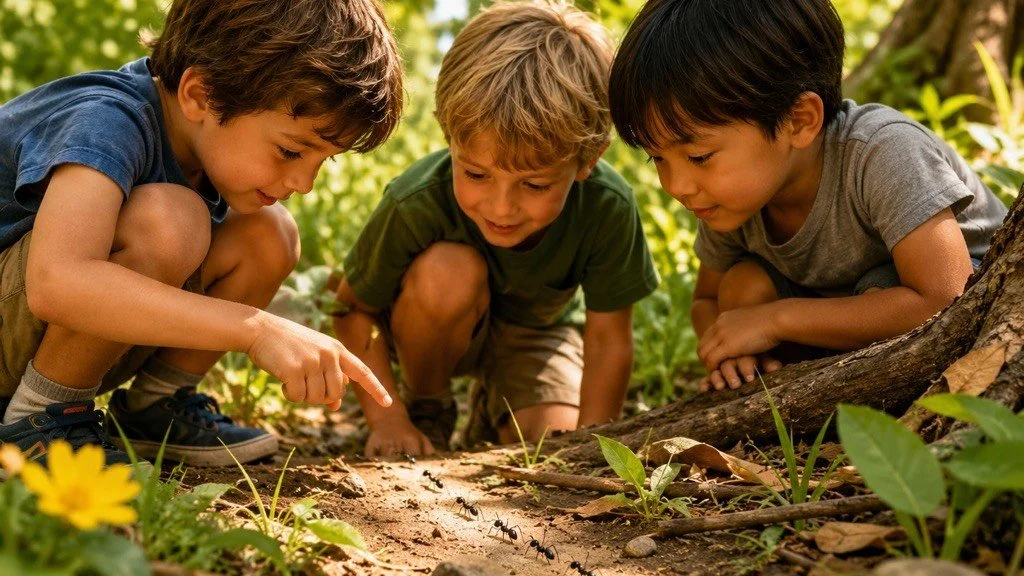
Children are astonishing local experts. Not in geography. In locality. They know exactly where the
fastest ants travel. Which tree has the roughest bark. Which puddle deserves
revisiting after every rain. Where the best stick lives. Which crack in the path hides
tiny worlds. They notice the ladybird everyone else walks past. The feather floating
on the breeze. The snail making very serious progress across the footpath. The
cloud that looks exactly like a dinosaur wearing gumboots.
Adults often manage time. Children cultivate wonder. Perhaps that is why they are
such remarkable educators. They remind us that awe doesn’t have to be booked into
our calendars, on weekends or holidays. It is usually waiting beside the sandpit. Or
hiding beneath a log. Or sitting quietly in someone’s pocket disguised as a very
important pebble.
There is something else these tiny alchemists know. Long before they understand
neuroscience, they understand relationship. They know that eyes can say, “I see
you.” That a smile can say, “You matter.” That open arms can say, “You are safe
here.” That gentle hands can say, “I’ll help.” That shared laughter can mend the
tiniest heartbreak. Without ever reading a textbook, they invite us into what it means
to be fully human.
Perhaps this is why early childhood education and care is such extraordinary work.
We don’t simply teach children. We become companions in wonder. We lend our
calm when storms arrive. Our curiosity when questions overflow. Our steadiness
when little worlds wobble. Our presence when words are not enough. And in return,
children lend us something adults too often lose along the way, a capacity for awe
that has not yet been crowded out by urgency. Their nervous systems seek
relationship. Ours respond. They borrow our calm. We borrow their wonder. Their
delight becomes contagious. Their curiosity rekindles ours. Their hope reminds us
what is possible. Together, we create something neither could create alone.
Perhaps this is what it means to belong. Not simply to live alongside one another, but
to become more fully ourselves because of one another. They remind us that
belonging isn’t something we earn. It is something we experience. That joy is serious
business. That play is a way of knowing. That wonder is a form of wisdom. That
relationships are where humans grow. And that perhaps the greatest gift children
give us is not what they learn from us…but who we become because of them.
Yes, I know the science. I have spent decades immersed in it. I know about oxytocin
and neuroception. About co-regulation and mirror systems. About stress hormones,
attachment and neuroplasticity. The science tells us that our brains, bodies and
hearts are shaped in relationship. It tells us why a baby’s cry stirs us, why a child’s
smile warms us, why shared laughter eases tension, why compassionate presence
can settle a distressed nervous system. The science is extraordinary. But it doesn’t
replace the magic. It explains why the magic is real.
So the next time a four-year-old proudly hands you a leaf they are absolutely certain
is treasure… Or a toddler solemnly presents you with a soggy stick as though it were
the Crown Jewels… Or a baby catches your eye and smiles as if you are the most
fascinating person who has ever lived… Smile back. Accept the treasure. Admire the
stick. Follow the ant. Listen to the impossible story. Wonder where the snail is going.
Remember that this fleeting moment is quietly shaping two nervous systems, not
one. That what feels magical is often biology at its most beautifully human. Tell me
it’s not magic.
Yours in Resilience
Dr Geraldine Harris